AI Strategy
/
feb 16, 2025
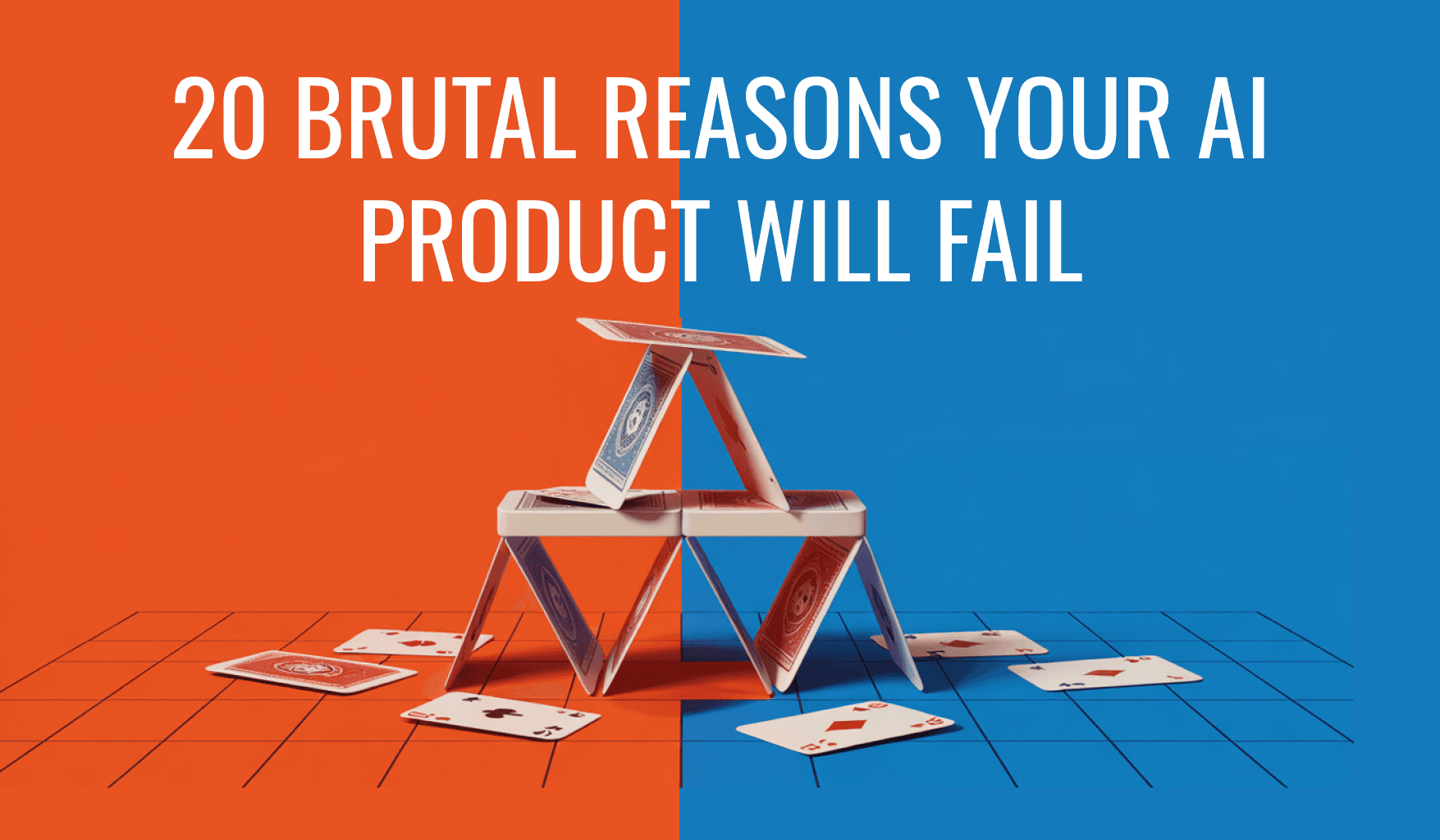
20 Brutal Reasons Your AI Product Will Fail
Hard truths learned from industry leaders, enterprise buyers, and dozens of AI founders who already made the mistakes you're about to make.
/
AUTHOR

Arpy Dragffy
Over the past year I’ve spoken with dozens of AI founders, enterprise innovation leads, product owners, and researchers across healthcare, finance, SaaS, transportation, government, retail, and consumer apps. The pattern is consistent:
AI has made prototyping unbelievably easy. AI has not made successful products any easier. The cost of building a POC is near zero. The cost of losing trust is enormous.
We’ve already seen extremely public failures:
Google Bard’s launch error (2023) contributed to a roughly $100B Alphabet market cap drop after a single inaccurate answer in the demo. Source: New York Times
Meta’s Galactica lasted less than 48 hours before being pulled after severe hallucination backlash. Source: MIT Technology Review
Amazon’s internal AI hiring system was shut down after learning to penalize women. Source: Reuters
Lawyers sanctioned for filing AI-invented cases show the real consequences of hallucinations. Source: BBC News
Zooming out:
MIT Sloan estimates roughly 95% of genAI pilots fail to produce measurable value. Source: MIT Sloan
BCG finds only 4% of companies realize substantial AI value at scale. Source: BCG – Driving Value from AI
McKinsey notes meaningful bottom-line AI impact “remains rare.” Source: McKinsey – The State of AI in 2023
This is the landscape your product enters.
Here are 20 real reasons your AI product will fail, unless you confront them directly.
1. You shipped because AI made it easy, not because the product was ready.
LLMs made it effortless to build something that looks impressive. A weekend of scaffolding and prompt-glue can produce a demo that feels like software. But a demo is not the same as a product that works daily across messy real-world workflows.
Founders conflate “easy to prototype” with “ready for market.”
Gartner warns that many AI projects will fail or be abandoned without proper foundations, AI-ready data, and clear goals. Source: Gartner – 2024 Hype Cycle for AI
A shaky AI product destroys trust instantly — and permanently.
2. You are trying to solve too much for too many people.
Founders pitch “AI for everyone.” Buyers want “AI for this one painful problem.”
When you try to solve everything, your product becomes:
too generic
too vague
too unfocused
too confusing
too inaccurate
BCG shows that companies generating real AI value focus on a small number of deep use cases, then expand. Source: BCG – Driving Value from AI
AI rewards focus.
3. Users fire your product because it can’t be trained in a meaningful or persistent way.
Most “AI personalization” is theatre:
thumbs-up/down does nothing
corrections are forgotten
memory resets
“learning” is shallow
fine-tuning doesn’t change the UX
the model repeats prior mistakes
Users realize:
“This thing doesn’t learn me.”
Salesforce’s global research shows lack of personalization is a top reason customers abandon AI assistants. Source: Salesforce – State of the Connected Customer
Your AI must learn, or users will leave.
4. Your model hallucinates or fails silently, and trust collapses instantly.
Hallucinations are catastrophic.
Stanford HAI found commercial legal AI tools hallucinate 17–33% of citations — even those marketed as “reliable.” Source: Stanford HAI – Legal AI Tools Frequently Hallucinate
A fabricated legal case is not a glitch. A hallucinated dosage is not a quirk. A bogus compliance recommendation is not “imperfect.”
It’s fatal.
5. You default to massive LLMs when small models or classical ML would work better.
Founders overuse LLMs because:
they demo well
investors expect it
it feels cutting edge
But Bain finds that companies getting ROI from AI use smaller, domain-specific models and classic ML, not only massive general LLMs. Source: Bain – Why You’re Not Getting Value from GenAI
Giant models ≠ better solutions.
6. Regulated buyers aren’t cautious. They’re afraid.
Industries like healthcare, finance, and government operate under auditability and liability, not “move fast and break things.”
A global study by KPMG and the University of Melbourne found only 46% of people say they trust AI systems, even when they see the benefits. Source: KPMG – Trust in Artificial Intelligence
If your product increases perceived risk even a little, you’re out.
Fear isn’t friction. Fear is a wall.
7. You’re selling AI instead of selling measurable outcomes.
Executives don’t want AI. They want:
revenue
accuracy
margin
throughput
lower risk
McKinsey shows most AI efforts fail not because of model quality, but because they are not tied to specific business outcomes and P&L drivers. Source: McKinsey – The State of AI in 2023
If your pitch is “AI-powered,” you’re selling tech, not transformation.
8. “Saving time” is not a business case.
Time savings alone is not why people buy.
Harvard Business Review summarizes experiments showing GPT models dramatically increase speed and output quality, but emphasizes that time savings only create value when leaders intentionally redeploy that time into higher-value work. Source: HBR – How GPT Models Boost Knowledge Worker Productivity
Everyone says they “save time.” Winning products show what time is used for.
9. You underestimate your true competition.
You’re not just competing with startups. You’re competing with:
Excel
PowerPoint and docs
Notion and Confluence
internal scripts and systems
ad hoc workflows
ChatGPT
“the way we’ve always done it”
McKinsey notes that even where AI is piloted, most workflows remain unchanged, so “good enough” tools keep winning by default. Source: McKinsey – Rewired and Running Ahead
Your true competitor is the status quo.
10. You are competing directly with ChatGPT and Google.
If a user can replicate your product with:
a well-crafted prompt
a custom GPT
a Gemini or GPT workflow
…you have a moat problem.
PwC’s AI predictions highlight that many early genAI use cases can be addressed with general-purpose models unless vendors provide differentiated data, workflows, or guarantees. Source: PwC – 2024 AI Predictions
Wrappers don’t last.
11. Organizational silos will suffocate your product.
Your product likely touches multiple teams:
Sales, RevOps, Legal
Support, Product, Engineering
Clinical, Compliance, IT
Risk, Finance, Ops
McKinsey’s “superagents” research shows a gap between frontline AI use and leadership/organizational readiness. When no one owns the end-to-end outcome, AI value dies in the gaps. Summary: Lewis Silkin – Superagency in the Workplace
If no team owns your outcome, your product suffocates in the org chart.
12. Your pricing model is misaligned with how value is created.
Common AI pricing issues:
seat-based pricing for agents
token/usage pricing that scares procurement
unpredictable cost curves
tiers that punish success
BCG identifies pricing misalignment as a central reason pilots fail to graduate to scaled deployments. Source: BCG – Where’s the Value in AI?
Pricing must feel aligned to value, or buyers won’t commit.
13. Your data architecture is too complex to operate or scale.
Many AI systems are over-engineered:
multiple vector DBs
nested RAG layers
microservices everywhere
several orchestration frameworks
McKinsey shows organizations that succeed with AI use simpler, integrated, and opinionated data/AI architectures instead of sprawling science projects. Source: McKinsey – Data and AI Transformation
Simplicity scales. Complexity collapses.
14. Your product does not meet enterprise governance or sovereignty needs.
Enterprises now demand:
regional data residency
strict retention policies
control over training data
explainability
auditability
KPMG’s global AI trust work indicates governance, transparency, and control are now the top concerns for leaders considering AI. Source: KPMG – Trust, Attitudes and Use of AI
If you can’t give a clear governance story, you’re not enterprise-ready.
15. Your UX feels like a developer toy, not a product.
Red flags:
unclear system state
ambiguous commands
fragile flows
unexplained failures
“just ask me anything” instead of guidance
Forrester’s work on anticipatory digital experiences shows customers reject systems that increase cognitive load and uncertainty. Example: Forrester – Anticipatory Digital Experiences
A magical demo is irrelevant if everyday use is confusing.
16. Your product instills fear, uncertainty, and political risk inside the organization.
Employees may be thinking:
“Will this replace me?”
“Will this expose inefficiencies?”
“Will this change my manager’s expectations?”
KPMG found 57% of workers hide their use of AI from employers due to fear and mistrust. Summary: Business Insider – KPMG AI Trust Study
If your tool feels like a threat, people will quietly resist it.
17. You never defined the workflow, the metric, or the ROI.
Most AI pilots die because no one can answer:
Which decision improves?
Which workflow changes?
Which metric moves?
By how much, and when?
BCG’s “Where’s the Value in AI?” finds only 4% of companies get significant value from AI because most projects never tie to concrete ROI. Source: BCG – Where’s the Value in AI? (PDF)
If you can’t do the math, buyers won’t either.
18. You chose the wrong interface for the job.
Chat feels cool, but it is often the wrong interface for:
approvals
audits
multi-step workflows
structured data entry
compliance workflows
Deloitte’s Enterprise Trust in AI research shows trusted AI is typically embedded in existing interfaces, not thrown into open-ended chat. Source: Deloitte – Enterprise Trust in AI Survey
Interface isn’t just UI — it’s product strategy.
19. Users prefer the devil they know.
People stick with familiar tools and workflows because they:
know how they fail
know how to fix them
have muscle memory
fear transition cost
Bain notes generative AI only creates value when organizations redesign processes and roles; otherwise, people revert to old habits. Source: Bain – Why You’re Not Getting Value from GenAI
Your product must be dramatically better — not slightly better — to beat “good enough.”
20. You lack a credible vision for how work will change.
Most founders can explain what their product does. Very few can explain:
what work looks like in 3 years with it
how roles shift
how decisions change
how humans and AI collaborate
McKinsey’s Rewired work on digital and AI transformations argues that leadership vision and willingness to rewire organizations are the core differentiators between winners and laggards. Source: McKinsey – Rewired
A product without a worldview is a feature. A worldview without a product is a manifesto.
You need both.
The Takeaway
AI will not save your product. Only value, trust, accuracy, workflow mastery, and a compelling vision will.
Your product must deliver:
accuracy and reliability
real personalization
a clear painful problem
measurable ROI
defensibility beyond prompts
governance readiness
simple architecture
intuitive UX
organizational alignment
a future worth believing in
AI lowered the barrier to creation. It raised the bar for adoption.