Product Resources
/
feb 16, 2025
Service Design in the Age of AI: How to Build Holistic CX and Intelligent Automation
Service design aligns AI, automation, and CX into one coherent system that scales experiences, not silos.
What Is Service Design Today?
As digital platforms, AI systems, and automation layers have grown more complex, service design has shifted from a “nice-to-have” discipline to a foundational business capability.
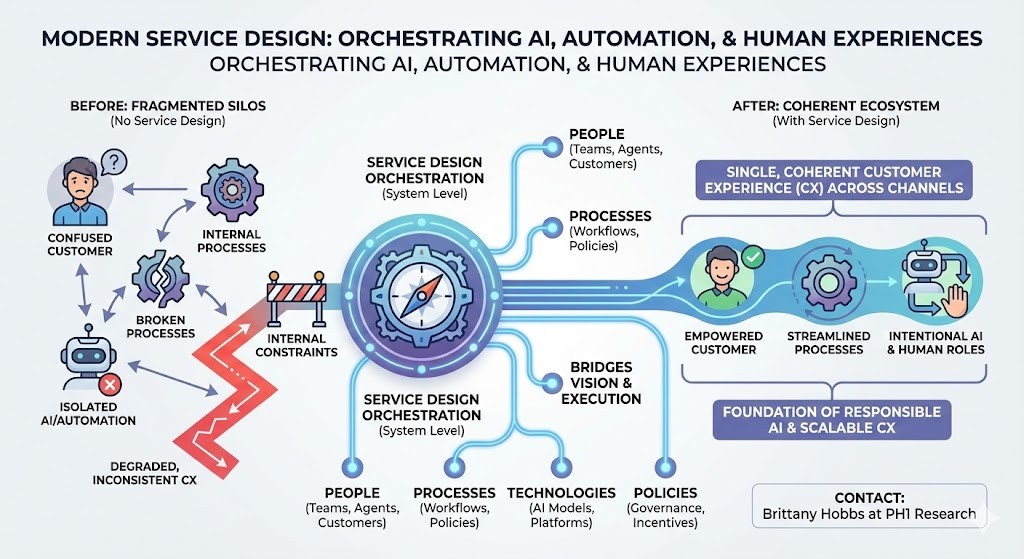
Modern service design is the intentional orchestration of people, processes, technologies, and policies so that multiple services work together as a single, coherent experience. It ensures that what customers see on the surface aligns with what happens behind the scenes, across teams, systems, and increasingly, AI-driven decision engines.
While product and UX design tend to focus on optimizing individual interactions or tasks, service design operates at the system level. It asks a different set of questions:
How do multiple touchpoints connect across time and channels?
Where do handoffs break down between humans, automation, and AI?
Which services should be automated, augmented, or redesigned entirely?
How do internal constraints (teams, incentives, data silos) shape customer experience?
In practice, service design is how organizations move from fragmented digital tools to holistic customer experience (CX) systems.
Why Service Design Is Essential for AI-Driven CX and Automation
AI does not exist in a vacuum. Models, agents, chatbots, and automation workflows are only as effective as the service ecosystem they are embedded in.
Without service design:
AI tools optimize isolated tasks while degrading the overall experience
Automation shifts cost but increases customer confusion
“Self-service” becomes “self-deflection,” pushing work onto customers
Teams deploy AI faster than they can govern or explain it
With service design:
AI is placed intentionally within the customer journey
Automation supports clear outcomes, not just efficiency metrics
Human and machine roles are explicitly defined
CX becomes measurable across systems, not just screens
Service design is the connective tissue between AI strategy, CX strategy, and operational reality.
What Service Design Solves: Airlines, OTAs, and the Cost of Fragmented Services
A classic example remains the airline and online travel agency (OTA) ecosystem.
Before the pandemic, most airlines prioritized revenue-generating products: search, booking, and payment. Supporting services like reservation changes, credits, refunds, and customer service tooling were under-invested because they were not direct profit centers.
When the pandemic hit:
Call volumes exploded due to cancellations and schedule changes
Legacy systems could not support scale or flexibility
Hold times soared, driving massive dissatisfaction and brand erosion
Operational costs increased at precisely the wrong moment
To survive, airlines and OTAs were forced to rapidly redesign their service ecosystems, prioritizing digital self-service, automation, and policy clarity.
A service design approach would:
Map the full end-to-end travel service ecosystem
Identify failure points between digital tools, policies, and human agents
Define which services should be automated vs. human-led
Design self-service workflows aligned to customer expectations
Ensure AI-driven tools (e.g., chatbots, change engines) fit into a coherent CX
This is not a UX problem. It is a service orchestration problem.
How Service Design Differs from UX and Product Design
UX design typically:
Lives within a single team
Optimizes screens, flows, and interactions
Focuses on usability and task success
Service design:
Cuts across teams, tools, and systems
Aligns digital, human, and automated services
Operates at the level of strategy, operations, and CX
Influences roadmaps, governance, and investment decisions
In AI-enabled organizations, service designers increasingly act as system architects, ensuring that automation, data, and decision logic reinforce—not undermine—the customer experience.
Why Organizations Must Budget for Service Design
Service design is often deprioritized because:
It spans multiple teams, making ownership unclear
Its ROI is distributed rather than localized
It exposes uncomfortable organizational truths
But as CX becomes a competitive differentiator—and AI accelerates system complexity—not investing in service design becomes far more expensive.
Organizations that fail to adopt service design at a strategic level experience:
Rising support costs despite automation
Fragmented AI initiatives with low adoption
Inconsistent brand experiences across channels
Erosion of trust due to opaque or poorly designed AI interactions
Companies like Uber and Airbnb are successful not because of a single interface, but because their business models are built on service orchestration. Hundreds of services—pricing, trust, logistics, payments, dispute resolution—are designed to feel like one experience.
That is service design as competitive advantage.
Examples of Modern Service Design Projects
At PH1 Research, we apply service design to complex digital and AI-enabled ecosystems. Typical engagements include:
Service ecosystem mapping for enterprise B2B platforms to identify gaps, redundancies, and opportunities for automation
CX and AI readiness audits to assess where self-service, AI agents, or workflow automation will actually improve outcomes
Customer support service redesign, including evaluation of deflection strategies, AI tooling, and human handoffs
Behavior-driven service design, mapping user mental models to personalized nudges, communications, and decision support systems
Future-state service blueprints that align CX vision, data strategy, and automation roadmaps
These projects are not about deliverables. They are about decision clarity.
The Modern Service Design Methodology
Contemporary service design blends:
Design thinking
Behavioral science
UX research
Systems thinking
AI and automation strategy
A typical service design process includes:
Investigating the problem space and business context
Mapping the current service ecosystem (digital, human, automated)
Understanding user behaviors, expectations, and constraints
Identifying intervention opportunities (process, policy, AI, tooling)
Designing and validating the future-state service ecosystem
Successful service design depends on a holistic understanding of three dimensions:
Connected services and touchpoints
Organizational systems, including teams, incentives, and constraints
Diverse users, with varying goals, mental models, and contexts
Service designers operate as hybrid researchers, strategists, and system designers, bridging vision and execution.
Service Design Is the Foundation of Responsible AI and Scalable CX
As organizations race to deploy AI, the risk is not that AI will fail—it’s that it will succeed locally while failing systemically.
Service design ensures that:
AI supports real customer outcomes
Automation reduces friction rather than shifting it
CX remains coherent across channels and time
Technology reinforces trust, not confusion
In short, you cannot scale AI responsibly without service design.
If you’d like to discuss how service design can support your AI, CX, or automation initiatives, contact Brittany Hobbs at PH1 Research. brittany@ph1.ca
/
BLOG
Other insights
News
/
Aug 13, 2026
Product Management & User Research Partner for Hire with the Experience You Need
digital-transformation
/
Jul 9, 2026
Search: The Digital Transformation Project Quietly Hurting Your Customers

digital-transformation
/
May 23, 2026