Product Resources
/
feb 16, 2025
Innovation Sprints in the Age of AI
Innovation sprints help organizations de-risk AI, explore new value, and turn complex service challenges into clear, evidence-based decisions.
/
AUTHOR

Arpy Dragffy
What Are Innovation Sprints?
Most organizations say innovation is a priority. Very few structure their work in a way that allows innovation to survive contact with reality.
When an initiative is placed on a long-term roadmap, it almost never moves forward. There is always a more urgent fire: a release deadline, a revenue target, a system outage, a regulatory concern. Meanwhile, executives, product leaders, and marketers are under constant pressure to identify new growth opportunities, efficiency gains, and competitive differentiation, particularly as AI reshapes entire industries.
The core problem is not lack of ideas.
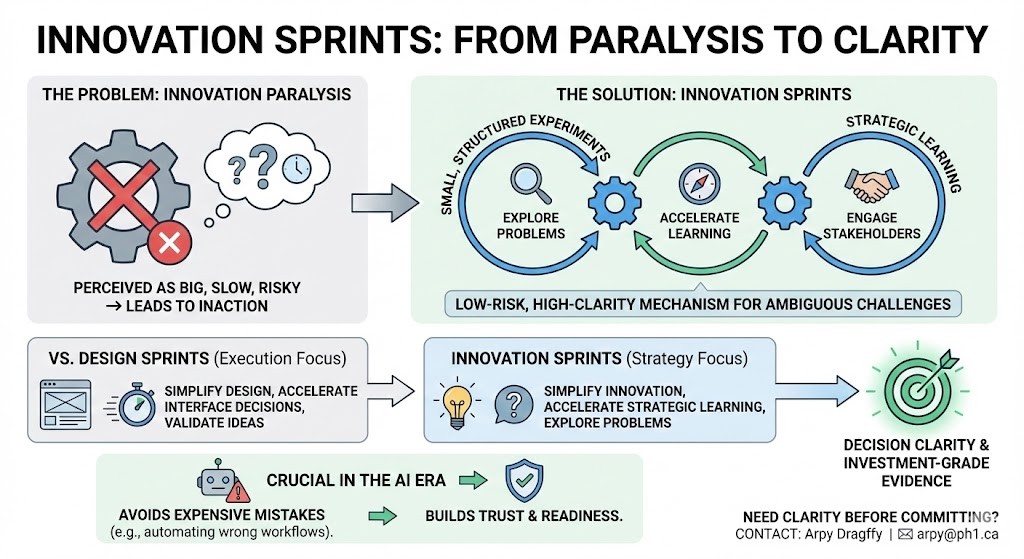
It is the belief that innovation must be large, expensive, slow, and risky.
The Myth vs. the Reality
Myth: Innovation happens on multi-year cycles and requires major upfront investment.
Reality: Innovation happens through small, structured experiments that reduce uncertainty before capital is committed.
Innovation sprints are designed to do exactly that. They are a low-risk, high-clarity mechanism for exploring complex, ambiguous challenges—especially those involving AI, automation, and emerging customer expectations.
Innovation Sprints vs. Design Sprints
Innovation sprints are often confused with design sprints, but they solve a different class of problem.
Innovation sprints differ in four critical ways:
Design sprints simplify design. Innovation sprints simplify innovation.
Design sprints accelerate interface and experience decisions. Innovation sprints accelerate strategic learning.Design sprints validate ideas. Innovation sprints explore the right problems.
Innovation sprints are used when the opportunity itself is unclear, poorly framed, or politically complex.Design sprints rely on local expertise. Innovation sprints activate distributed expertise.
Innovation sprints intentionally engage stakeholders across product, data, operations, legal, CX, and leadership—because innovation constraints rarely sit in one team.Innovation sprints build investment-grade evidence.
They integrate qualitative research, quantitative analysis, and rapid experimentation to answer a single executive question:
Is this worth funding—and why?
In the AI era, this distinction matters. Most AI initiatives fail not because the technology doesn’t work, but because organizations skip the discovery work required to understand where AI actually creates value.
Why Innovation Sprints Matter More in an AI-Driven World
AI dramatically increases the speed of execution—but it also increases the cost of being wrong.
Without innovation sprints, organizations:
Automate the wrong workflows
Deploy AI tools customers don’t trust or adopt
Optimize efficiency at the expense of experience
Invest in platforms without a clear value hypothesis
Innovation sprints create a controlled environment to test assumptions about:
Data availability and quality
Customer willingness to engage with AI-driven services
Organizational readiness for automation
Ethical, regulatory, and trust implications
They slow teams down just enough to avoid expensive mistakes.
Example: Innovation Sprints in an Ad-Supported News App
Most ad-supported digital products rely on two revenue levers:
Show more ads
Increase cost per click (CPC)
The first option degrades user experience, increases churn, and weakens brand trust. The second depends on relevance, which in turn depends on data.
Here’s the hidden constraint:
Despite common assumptions, iOS and Android significantly limit what apps know about users. Most first-party data is shallow, incomplete, or inferred.
The real innovation challenge is not ad technology.
It is designing a value exchange that makes users comfortable sharing meaningful data.
How Innovation Sprints Address This
An innovation sprint would:
Research what users believe apps know about them vs. what they actually know
Test different value propositions for first-party data sharing
Explore AI-driven personalization without violating trust
Validate which data points meaningfully improve relevance
Quantify revenue upside vs. churn risk
A challenge like this typically requires multiple two-week sprints, each focused on a different layer: trust, incentives, experience design, data strategy, and monetization.
Crucially, stakeholders are engaged before, during, and after each sprint to ensure solutions align with:
Brand promise
Technical feasibility
Legal and privacy constraints
Long-term CX strategy
Why Organizations Need Innovation Sprints (Even When They’re Busy)
Innovation challenges are rarely moonshots.
They just feel that way because the problem space is blurry.
Innovation sprints turn distant, abstract goals into clear milestones:
What problem are we really solving?
What assumptions are we making?
What evidence do we need to move forward?
They also acknowledge a hard truth:
Product teams do not have spare capacity.
Innovation sprint methodology is designed to work in two modes:
Part-time internal teams, using structured tools to build alignment and evidence
Externally led sprints, where experienced facilitators handle research, synthesis, and stakeholder engagement
In both cases, the output is not “ideas.”
It is decision clarity.
Innovation Sprints as a Foundation for Service Design and AI Strategy
Innovation sprints rarely exist in isolation. They often feed directly into service design initiatives, particularly when AI and automation are involved.
At PH1 Research, innovation sprints frequently support:
Service ecosystem redesign
CX transformation programs
AI readiness and automation strategy
Policy and governance decisions
Investment prioritization
They are how organizations explore what could exist before committing to what should exist.
Examples of Service Design Projects at PH1 Research
PH1 Research is a Vancouver-based research and strategy consultancy founded in 2012. We specialize in untangling complex digital, service, and AI-enabled ecosystems.
Representative projects include:
Mapping connected services for a leading B2B distributor to identify where automation and new services would create the most value
Auditing customer support ecosystems to determine which services should be redesigned, automated, or retired to reduce call volume
Designing personalized, behavior-driven digital support systems for public health and behavior change initiatives
These engagements combine service design, innovation sprints, and applied research.
The Service Design Methodology We Apply
Our approach integrates:
Design thinking
Behavioral science
UX and CX research
Innovation sprint methodology
Systems and organizational analysis
Core phases include:
Investigating the problem space
Mapping the current service ecosystem
Understanding behaviors, expectations, and constraints
Evaluating potential interventions
Designing the future-state service ecosystem
Successful outcomes depend on understanding three interconnected dimensions:
Services and touchpoints
Organizational systems and incentives
User mental models and real-world context
Innovation Is a Discipline, Not a Department
In the AI era, innovation is no longer optional—but unmanaged innovation is dangerous.
Innovation sprints provide a repeatable, defensible way to explore new opportunities without overcommitting resources or eroding trust. They help organizations move faster by learning earlier.
Interested in Running an Innovation Sprint?
If you’re exploring AI, automation, or complex service challenges and need clarity before committing to large investments, innovation sprints are often the fastest path forward.
To discuss an innovation sprint or service design engagement, contact
Arpy Dragffy
📧 arpy@ph1.ca
/
BLOG
Other insights

News
/
Aug 13, 2026
Product Management & User Research Partner for Hire with the Experience You Need

digital-transformation
/
Jul 9, 2026
Search: The Digital Transformation Project Quietly Hurting Your Customers

digital-transformation
/
May 23, 2026