Insights
/
feb 16, 2025
Fandom, Creators, and Personalization in the Age of AI
How fandom, creators, and AI-driven personalization reshape engagement, monetization, and community—and how brands can build durable advantage.
/
AUTHOR

Arpy Dragffy
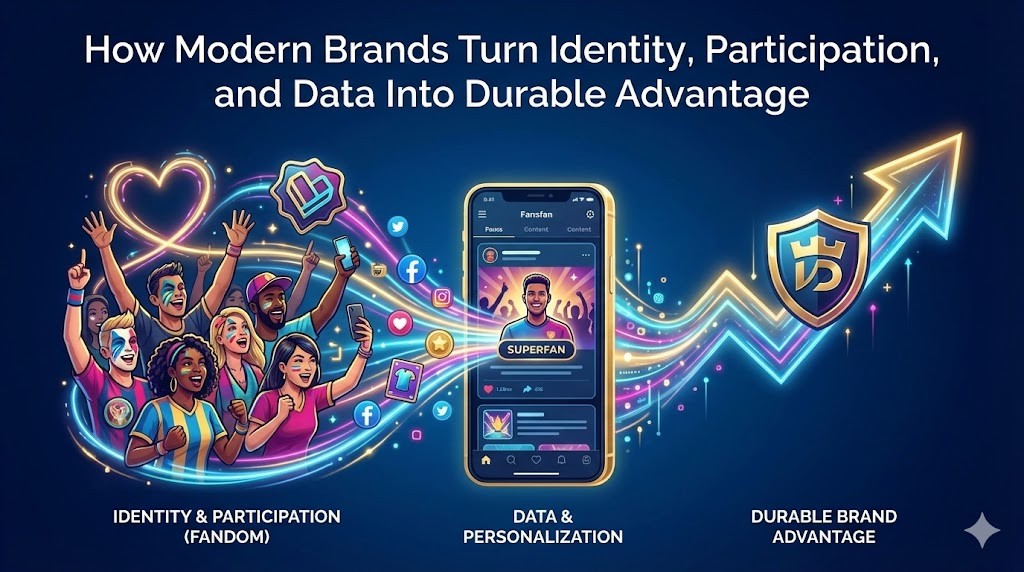
How Modern Brands Turn Identity, Participation, and Data Into Durable Advantage
Everyone is a fan of something.
Fandom is not casual interest—it is a deeply personal expression of identity, memory, and belonging. It forms around moments that feel emotionally complete, even when they are fleeting. Fandom is how people anchor meaning in an increasingly fragmented digital world.
This is why fandom resists logic. Like falling in love, it cannot be argued away. Attempts to rationalize or “optimize” fandom without understanding it often backfire.
From a business perspective, fandom is one of the most powerful and misunderstood forces in modern markets. Superfans are not simply high-LTV customers. They are identity-aligned participants who invest time, money, creativity, and advocacy to sustain what they care about.
Think of the uncle whose most valuable possession is an autographed photo from a single playoff game decades ago. Or the friend who plans entire years around seeing their favorite band live. These behaviors are not irrational—they are signals of deep emotional capital.
The opportunity is not just monetization.
It is designing systems that respect different depths of attachment, enable participation, and personalize value delivery at scale.
Why Fandom Matters More Than Ever
Three structural shifts have fundamentally reshaped fandom in the last decade.
1. The Creator Economy Has Rewired Trust
Fans increasingly form primary emotional connections with creators, not institutions. Research from SignalFire shows that the creator economy continues to expand in both size and sophistication, with creators diversifying revenue streams beyond ads into subscriptions, communities, and direct fan support
(Source: SignalFire – The Creator Economy Is Still Just Getting Started).
Similarly, Andreessen Horowitz (a16z) has documented how creators now operate as independent businesses, where audience trust and ownership—not platforms—are the core assets
(Source: a16z – Creator Economy).
Goldman Sachs projects the creator economy could exceed $480B by 2027, driven by personalization, niche fandoms, and direct monetization models
(Source: Goldman Sachs – Creator Economy Forecast).
This shift matters because fandom is no longer something brands “own.” It is something they must enable, respect, and participate in.
2. Fandom Is About Identity, Not Marketing
Strategist Zoe Scaman has been especially influential in reframing fandom as an identity system, not a marketing channel. She argues that the strongest brands and communities don’t run campaigns—they build worlds that people want to belong to
(Source: Zoe Scaman, Bodacious / Anomaly – essays and talks).
This aligns with decades of research on participatory culture by Henry Jenkins, who demonstrated that fans want to contribute meaningfully, not passively consume
(Source: Confronting the Challenges of Participatory Culture, MacArthur Foundation).
Together, these perspectives explain why modern fandoms behave less like audiences and more like micro-societies with shared values, norms, and hierarchies of participation.
3. Personalization Is Now the Baseline
Personalization is no longer a “nice to have.” It is the default expectation.
McKinsey research shows that effective personalization can drive 10–15% revenue lift and materially reduce churn—but only when it reinforces trust and relevance, rather than feeling extractive or invasive
(Source: McKinsey – The Value of Getting Personalization Right).
Spotify Wrapped is a canonical example of personalization functioning as cultural infrastructure, not just a UX feature. By turning personal listening data into a shared ritual, Spotify transformed data into fandom
(Source: Spotify Newsroom; Spotify Engineering Blog).
Similarly, TikTok’s “For You” system demonstrates how AI-driven discovery doesn’t just distribute content—it creates fandom by matching people to creators, narratives, and communities they didn’t know they were looking for
(Source: TikTok Business Blog).
The Core Monetization Insight: Fandom Is Stratified
The most common mistake organizations make is treating fandom as a single segment.
In reality, fandom exists on a spectrum:
Consumers (utility-driven)
Fans (emotionally attached)
Superfans (identity-aligned)
Each tier values different things:
Access vs. recognition
Convenience vs. belonging
Ownership vs. influence
Classic pricing theory (e.g., Nagle & Müller’s value-based pricing) supports this, but few organizations apply it rigorously to fandom. Instead, they underprice superfans and over-serve casual audiences.
Events, scarcity, and secondary markets have historically worked because they naturally introduce:
Rarity
Tiered access
Social signaling
Shared emotional moments
But traditional Web2 systems struggle to scale these dynamics or personalize them meaningfully.
Web2 vs. Web3 Is the Wrong Debate
If your goal is simply to monetize content, Web2 tools—Patreon, Substack, Discord, Shopify, YouTube memberships—are more than sufficient.
Web3 becomes relevant only when fandom itself is strategic.
As Chris Dixon argues in Read Write Own, programmable ownership and portable identity matter when communities, not platforms, are the long-term source of value.
Matthew Ball’s work on digital economies and the metaverse further reinforces this: ownership, status, and participation are core economic primitives in digital worlds—not speculative add-ons.
NBA Top Shot is often cited because it successfully combined:
Verifiable scarcity
Secondary market liquidity
Social status signaling
Large-scale community participation
(Source: Dapper Labs / NBA Top Shot blog).
Today, the most resilient fandom systems are hybrid architectures:
Web2 UX and distribution
Web3 primitives where they add leverage
AI for personalization, moderation, and discovery
Creator-led value creation
These hybrid systems are a recurring focus in PH1 Research’s work and are frequently explored on the Design of AI podcast, where we examine how technology reshapes behavior, trust, and experience—not just products.
A Practical Framework for Monetizing Fandom
1. Research What Emotionally Unites the Fanbase
Fans are united by emotional jobs-to-be-done, not features. This becomes the cultural thesis of the ecosystem.
2. Identify What Actually Stratifies Fans
Depth of attachment is driven by exposure, relevance, narrative alignment, and identity reinforcement—not just income.
3. Design Reciprocal Value Flows
Modern fandoms must allow value to flow between fans, creators, and the system itself. AI increasingly enables this at scale.
4. Co-Design the Brand–Creator–Community Architecture
Whether you’re building a creator platform, marketplace, or identity system, clarity and comprehensibility matter more than novelty.
5. Iterate With the Community
AI and analytics enable real-time learning, but the governing principle remains unchanged:
Communities inform decisions. Executives enable them.
Why PH1 Research Works in This Space
PH1 Research operates at the intersection of:
Fandom and digital communities
Creator-led ecosystems
AI-driven personalization
Service design and experience strategy
Web3 and hybrid platform models
Our work synthesizes academic research, industry data, and applied strategy into decision-ready insights. Through our consulting engagements and the Design of AI podcast, we explore how systems—not interfaces—create durable value.
The Future of Fandom
The future of fandom is:
Personal, not mass-market
Participatory, not extractive
Programmable, but not dehumanized
Organizations that treat fandom as a revenue lever will exhaust it.
Organizations that treat it as a system of belonging will compound its value.
If you’re exploring how fandom, creators, personalization, or AI-driven ecosystems could become a competitive advantage, PH1 Research can help you design the right path forward.
Listen to the Design of AI podcast or contact us to continue the conversation.
/
BLOG
Other insights
News
/
Aug 13, 2026
Product Management & User Research Partner for Hire with the Experience You Need
digital-transformation
/
Jul 9, 2026
Search: The Digital Transformation Project Quietly Hurting Your Customers

digital-transformation
/
May 23, 2026