Tips
/
feb 16, 2025
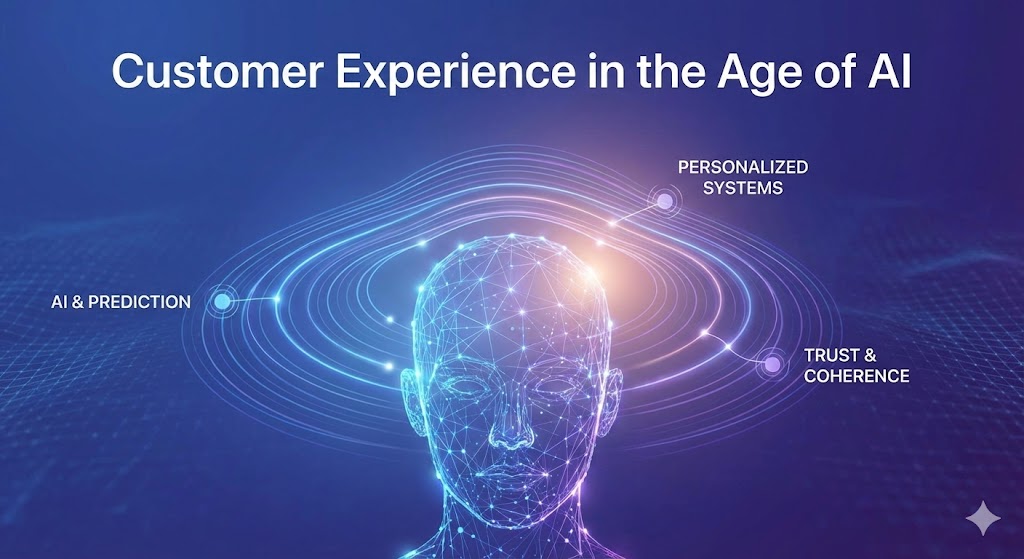
Customer Experience in the Age of AI
How AI is transforming customer experience from reactive journeys to predictive, personalized systems—and why CX must become core infrastructure, not a function.
/
AUTHOR

Brittany Hobbs
What Customer Experience Looked Like in 2020
In 2020, most organizations defined customer experience (CX) as a cross-functional capability that sat alongside product, marketing, sales, and support. CX teams were responsible for journey mapping, Voice of Customer (VoC) programs, satisfaction metrics, and cross-team alignment.
This operating model was heavily influenced by the idea that journeys are the unit of competition, a framing popularized throughout the 2010s by firms such as Forrester and McKinsey (see Forrester – The Six Disciplines of Customer Experience: https://www.forrester.com/report/the-six-disciplines-of-customer-experience/).
CX work at the time was largely reactive: identify pain points, prioritize fixes, and measure improvement after release. Analytics could show where friction occurred, but rarely why it happened or how to resolve it systemically.
Typical CX tooling in 2020 included:
CSAT, NPS, and CES surveys
Call-driver analysis
Qualitative interviews and diary studies
Funnel and conversion analytics
Early chatbots focused primarily on deflection
Personalization existed, but it was largely rules-based and segment-driven. Even strong CX teams struggled because journeys were still owned by functions rather than end-to-end systems.
The Uncomfortable Truth #1
Most CX teams are still operating with a 2020 mandate—while customer expectations have moved on.
What Customer Experience Means Now (2025)
AI has fundamentally changed what customers expect and what organizations are capable of delivering. CX is no longer something a single team can own. It is an emergent property of systems: data architecture, decision logic, automation rules, AI models, policy constraints, and human workflows either cohere—or they do not.
Research from McKinsey – The Value of Getting Personalization Right shows that customers increasingly expect personalized experiences as a baseline and are more likely to churn when interactions feel generic or inconsistent (https://www.mckinsey.com/capabilities/growth-marketing-and-sales/our-insights/the-value-of-getting-personalization-right).
Uncomfortable Truth #2: Most organizations still call “segmentation plus templates” personalization. Customers can tell.
From Reactive to Predictive CX
Historically, CX relied on lagging indicators such as churn, complaints, and satisfaction scores. AI now enables predictive CX: detecting friction through behavioral signals, anticipating intent, and routing customers to resolution paths earlier.
Salesforce documents this shift clearly in State of the Connected Customer, which highlights rising expectations for anticipatory, consistent service across channels (https://www.salesforce.com/resources/research-reports/state-of-the-connected-customer/).
Uncomfortable Truth #3: Predictive CX fails less because of models and more because of fragmented data and misaligned operating models.
Personalization Is Shifting from Segments to Individuals
True personalization now means individual-level adaptation over time, not persona-based experiences.
Leading consumer platforms demonstrate what is possible when CX is treated as a decisioning system:
Spotify Engineering – Personalization and Recommendation Systems describes personalization as “millions of versions of Spotify” driven by machine learning (https://engineering.atspotify.com/2021/02/spotifys-recommendation-system/).
Netflix Tech Blog – Personalization details multi-layer recommendation systems that adapt continuously (https://netflixtechblog.com/tagged/personalization).
Uncomfortable Truth #4: Customers compare your experience to the best digital experiences they use anywhere—not just your competitors.
CX Now Includes Machine Behavior
Customers increasingly experience:
Chatbots and voice assistants
Recommendation engines
Automated approvals and eligibility decisions
Dynamic pricing and proactive offers
If these systems are opaque, inconsistent, or wrong, the customer experience is broken regardless of interface quality.
Key governance and trust resources shaping modern CX:
NIST – AI Risk Management Framework (https://www.nist.gov/itl/ai-risk-management-framework)
Google PAIR – People + AI Guidebook (https://pair.withgoogle.com/guidebook/)
EU Artificial Intelligence Act (https://artificialintelligenceact.eu/)
IBM Institute for Business Value – AI Governance (https://www.ibm.com/thought-leadership/institute-business-value/report/ai-governance)
McKinsey – Why Explainable AI Matters (https://www.mckinsey.com/capabilities/quantumblack/our-insights/why-explainable-ai-matters)
Uncomfortable Truth #5: “We can’t explain why the system did that” is becoming a CX, legal, and reputational liability.
What Will Be Possible by 2030
Agentic CX Will Replace Navigation
By 2030, customers will increasingly delegate outcomes rather than navigate interfaces. Gartner outlines this evolution in its research on customer service AI and automation feasibility (Gartner – Customer Service AI: https://www.gartner.com/en/customer-service-support/insights/customer-service-ai).
CX teams will design goal-completion systems, not flows.
Personalization Will Be Governed, Not Hidden
Winning experiences will balance context, consent, and control. Spotify’s introduction of explicit personalization controls signals this direction (Spotify Newsroom – Personalization Controls: https://newsroom.spotify.com/2023-09-13/spotify-introduces-new-personalization-controls/).
Uncomfortable Truth #6: The most trusted brands will not be the most personalized—they will be the most transparent.
CX Measurement Will Shift from Scores to System Health
By 2030, leading organizations will measure:
Journey completion confidence
Quality of automation containment
Exception handling speed
Transparency and trust adherence
Personalization error rates
Forrester’s work on The Business Impact of Customer Experience points to this evolution from scorekeeping to system performance (https://www.forrester.com/report/the-business-impact-of-customer-experience/).
Where PH1 Research Fits
PH1 Research is typically engaged when organizations have CX insights but struggle to translate them into action—especially as AI and automation introduce new complexity.
Our work includes:
CX North Stars that translate into decision criteria
Service ecosystem mapping to identify where AI should and should not be deployed
AI and CX readiness across data, governance, and workflows
Cross-functional operating models that make CX executable
This systems perspective is also central to the Design of AI podcast, where we examine how AI reshapes experience, trust, and human behavior.
The Final Uncomfortable Truth
You cannot automate your way out of a broken CX system. And you cannot outsource customer experience to a single team.
AI makes exceptional CX possible—but only for organizations willing to rethink ownership, incentives, and foundations.
Customer experience is no longer about delight. It is about relevance, coherence, and trust at scale.
If you want to explore what this means for your organization, PH1 Research can help. Contact Brittany Hobbs to discuss a CX or AI-enabled transformation initiative.
/
BLOG
Other insights
News
/
Aug 13, 2026
Product Management & User Research Partner for Hire with the Experience You Need

digital-transformation
/
Jul 9, 2026
Search: The Digital Transformation Project Quietly Hurting Your Customers

digital-transformation
/
May 23, 2026